
Intelligence,
embodied.

Physical AI Platform for Safe Robotics Autonomy

Xolver is a physical intelligence platform providing robotics foundation models, a deterministic enforcement layer, and embedded runtimes for safe, auditable machine operations.

It is designed as an embedded translation device, an edge runtime, and a model layer you can evaluate.

What you get
  • Embedded Device
  • Edge Runtime
  • Model APIs & Weights

In pilots today, production in constrained environments.

Works with standard robotics middleware and industrial controllers.

We start with a technical assessment, then a controlled pilot.
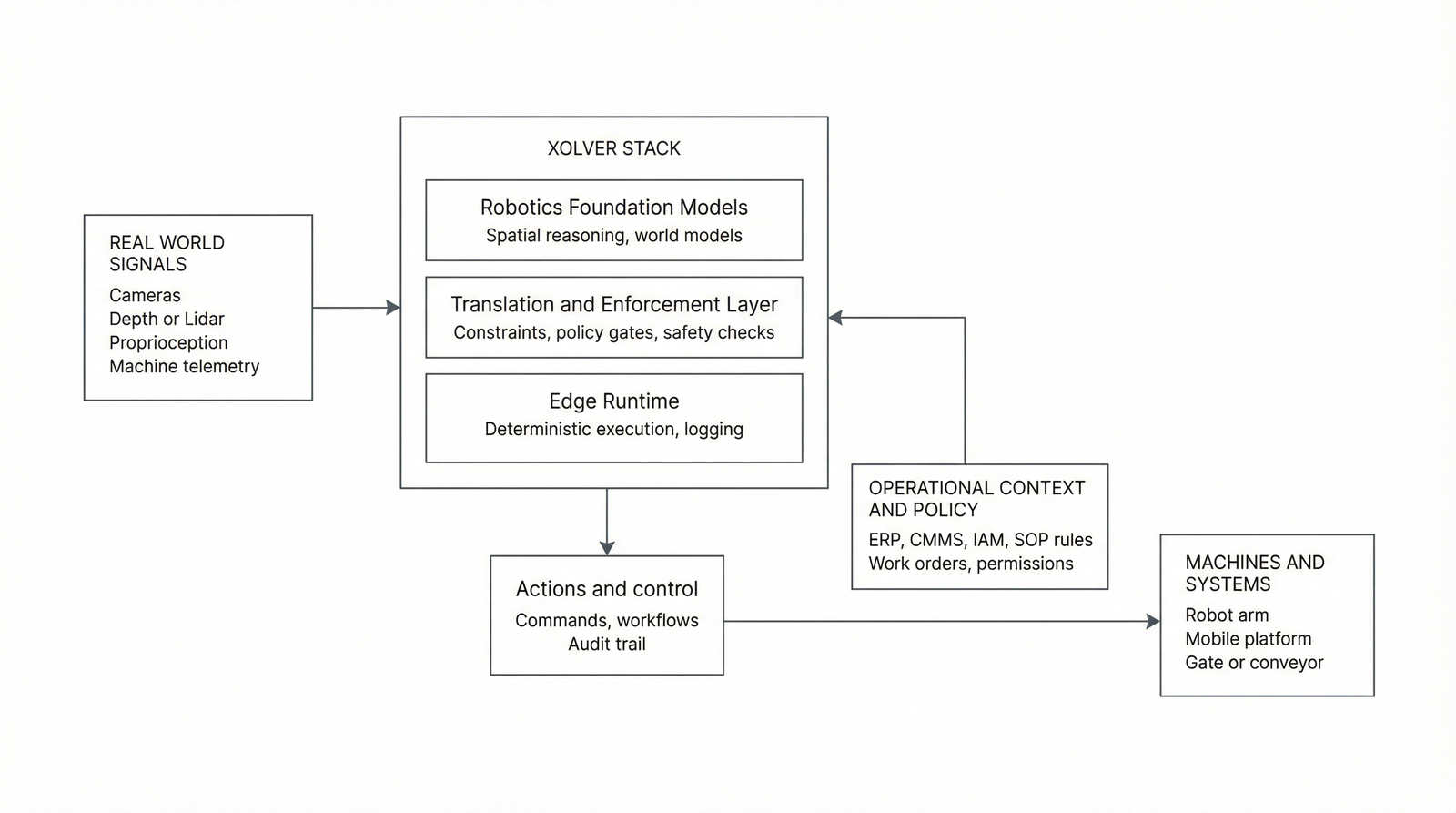
Xolver Control Spine Architecture diagram showing three layers: Robotics Foundation Models, Translation and Enforcement Layer, and Edge Runtime for physical AI systems
NVIDIA Inception Program Member

Industry Partnership

Xolver is a member partner of NVIDIA Inception program that nurtures cutting-edge startups. We leverage the NVIDIA ecosystem to scale our foundation models from research to high-stakes physical environments.

AWS Startups Program Member

Cloud Infrastructure

Xolver is supported by the AWS Startups program, leveraging AWS Activate credits and benefits under the Activate Portfolio. This enables us to build and scale our high-performance robotics infrastructure with enterprise-grade cloud services.

Why Xolver

Why this architecture exists.

Physical systems do not fail because perception is useless. They fail because interpreting the world is not the same as deciding what a machine is allowed to do next.

The hard problem is not generating intent. It is turning intent into physical behavior without losing safety, policy, or control.

Core Principle

What bounded autonomy means.

Bounded autonomy is a design principle for physical systems. Learned models can interpret, adapt, and propose, but physical action remains governed by explicit limits.

That keeps autonomy useful under real operating conditions instead of depending on ideal scenes, perfect connectivity, or unchecked model confidence.

Overview

Infrastructure for physical autonomy.

Models propose, enforcement constrains, runtime executes. Xolver separates these roles so perception, validation, and execution do not collapse into a single unchecked loop.

Where ERP Fits

ERP and IAM feed policy and permissions, not perception.

  • Models output world state & task intent
  • Enforcement outputs allowed actions
  • Runtime outputs execution traces